Showing posts with label GK. Show all posts

Saturday, June 1, 2013

What are Bonsoi ?


Bonsai (bone-sigh) is Japanese for tree in a pot.
The practice of bonsai is sometimes confused with dwarfing, but dwarfing generally refers to research, discovery, or creation of plant cultivars that are permanent, genetic miniatures of existing species. Bonsai does not require genetically dwarfed trees, but rather depends on growing small trees from regular stock and seeds. Bonsai uses cultivation techniques like pruning, root reduction, potting, defoliation, and grafting to produce small trees that mimic the shape and style of mature, full-size trees.
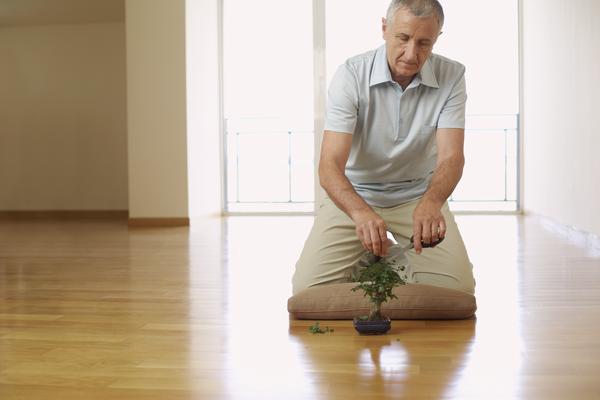
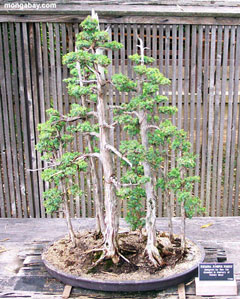

 However, simply placing a tree in a tiny pot does not make it bonsai. The grower must possess vision and skill to train the tree's foliage and guide its shape. This is done through pruning the roots to keep the tree small, wiring the branches, and using other techniques to make the bonsai tree take on the look of a mature tree in nature.
Bonsai also require special care because of the small amount of soil in which they grow. The trees cannot have "wet feet" so special bonsai soil is used which dries out easier than standard houseplant soil. But because there is so little soil, bonsai require frequent small waterings. A moisture meter can be used to let you know when the bonsai tree requires water.
Bonsai must also be fed nutrients in spring and fall. The three most important nutrients are nitrogen, phosphoric acid and potash, but chelated iron is also a good idea. It may be beneficial to rotate fertilizer brands since they each contain varying trace elements.
Trees that grow in nature enjoy humidity that is missing from an indoor environment. It is therefore recommended the bonsai pot sit in a shallow tray with water that can be allowed to evaporate in order to add humidity to the air surrounding the tree. A flat rock or pebbles should be placed in the tray under the pot so that the bonsai is not sitting in the water. Again, the roots of the bonsai tree should not be kept wet.

Sunlight is required for bonsai except under special circumstances, such as when they have just undergone extensive pruning or repotting. A southern, western or eastern exposure will be necessary inside the house so that the tree receives bright sun. If it cannot get direct sun you should select a bonsai tree that can grow in reduced sunlight, or plan to put your bonsai outside for several hours each day.
The goal with bonsai is to achieve the desired shape while balancing the growth above ground with the root growth. The process of shaping begins right away while the tree is very young, and continues while it matures. Small growth can be trimmed away with sharp scissors, but larger branches need a concave cutter which will not leave visible scars.
Some people use copper wire to train their bonsai tree. The wire is carefully coiled around the branches in the direction you wish them to grow. Once a branch is wrapped it is bent once into the final position. The wire should be snug without biting into the tree. Six to twelve months later, before the wire starts biting the bark, it is snipped away at each turn or coil so that it drops away. Uncoiling the wire without cutting it will damage the branch.
Some popular styles of bonsai include: formal and informal upright, cascade, windswept, slanting and forest, but there are countless variations and many more styles. In fact the only thing limiting the bonsai tree is the vision of the grower.

Friday, May 31, 2013

DISH TV

DISH TV

What went wrong with old roof top antenna we use to have years back?
Roof top antennas are made of aluminium and catch nearby TV station signal which is free of charge in India. Telecast is done by Doordarshan. These antennas catch analog signal which is not of good quality. Many of hilly region, valley houses or remote houses do not get good signal quality. There are not many channels available with old aluminium pipe antennas.
How does Cable TV work?
Cable TV was invented to solve the problem of the people who live in valley or remote locations where signals are not strong. Cable operator use to put antenna up on hill and send amplified signal to multiple houses in valley.
Nowadays cable operators installs Big dish antennas to receive TV broadcast from channels and pays on behalf of us to TV channel network. Cable Operator receives many channels through multiple dish antennas and puts them into single wire with different frequencies. You can take the same cable to multiple TV sets in the home and play different channels by paying minimum charge or no extra charge.
What is Set Top Box (STB) for Cable TV?
CAS is set top box for conventional cable TV. Years back Indian Government tried to enforce consumer rights with the help of CAS (Conditional Access System). With the help of CAS on cable tv it is possible to offer different set of channels for each consumer. in 2001 Government attempted to bring Free To Air channels to subscribers for as low as Rs. 80. Because of issues from cable operators, Satellite TV operators, set top box manufactures & political parties CAS didn't succeed. This has given great opportunity to Satellite TV operators to increase their penetration in ever growing Indian Television Market.
What is DTH Dish Television?
DTH stands for Direct To Home service which is terminology for Satellite Television. Compared to Cable TV here you have your very personal equipment which allows you to speak to distributor directly through Satellite. No hassles or chaos of Cablewalas.
Advantages
  • Personal Equipment to directly speak to Satellite for TV Broadcast.
  • Digital signaling gives you great quality when you connect your TV with AV cable or connect your 5.1 speakers with STB.
  • Facilities like Movie on Demand and Active/Interactive Services.
  • Some DTH vendors also offer Radio services.
  • Latest movies can be viewed at nominal cost (Kills the piracy)
  • You may actually save money
Disadvantages
  • During the monsoon season if there are thick clouds above your Dish Antenna, there will be reception problem.
  • Television in multiple rooms will require additional Digicomp and service charge.
  • You will miss local news channel
What you need to have to receive Satellite TV signal (DTH Dish)?
You need to have these
  • Digicomp set top box.
  • Dish Antenna (LNB).
  • An account with Service Provider (Smart card).
What is IP TV?

IP TV runs on ethernet network. There is better uplink bandwidth available in IP TV which assures more interactivity. There are limited vendors offering IP TV. 

What is DVR ?
DVR stands for Digital Video Recorder. This is special set top box, which is also doing recording while you are watching any channel. So you can pause the channel and resume where you left. You can also do recording of some other channel while you are watching different channel. Tata SKY Plus was first to be offered in this category. Each DVR box comes with different quality of content to be stored and limits on hours of recording.

What is HD set top box?
Usual Television set with CRT tube is not capable of producing picture more than 480 lines with limited depth of colors. New Generation LCDs can reproduce image quality upto 1080 lines detailing and beyond. If you have LCD with 1080i or above resolution, this is known as High Defination television. 1080i gives you 5 times clearer picture quality. Unfortunately Cable Transmission or Regular DTH dish tv transmission is not capable of utilizing your LCD capability. Old standard transmission works with 4:3 aspect ratio which is like square where as HD offers you 16:9 aspect ratio which is like rectangle the way LCDs are designed today. Old starndard give mono or stereo sound output. HD offeres you 5.1 audio output. This goes to two rear left+right speakers, two front left+right speakers one center and one to woofer. Giving you realistic natural sound quality. Earlier TVs were connected with RF cable, current set top boxes offer 3 pin AV cables. For HD you need to have HDMI port on television. HDMI port is essential part of HD set top box.
If you do not have LCD with 1080i resolution or 5.1 music system, you wont be able to take advantage of HD channels. Regular CRT television is not made for HD transmission. Currently there are only few channels which are offered with HD broadcast. So if you think you are ready to experiment with this new technology you can go ahead with this.

Thursday, May 30, 2013

Pancreatitis disease

The pancreas is a large gland located behind the stomach and next to the duodenum (the first section of the small intestine). The pancreas has two primary functions:

1. To secrete powerful digestive enzymes into the small intestine to aid the digestion of carbohydrates, proteins, and fat
2. To release the hormones insulin and glucagon into the bloodstream; these hormones are involved in blood glucose metabolism, regulating how the body stores and uses food for energy.

Pancreatitis is a disease in which the pancreas becomes inflamed. Pancreatic damage occurs when the digestive enzymes are activated before they are secreted into the duodenum and begin attacking the pancreas.


There are two forms of pancreatitis: acute and chronic.

    Acute pancreatitis:     Acute pancreatitis is a sudden inflammation that occurs over a short period of time. In the majority of cases, acute pancreatitis is caused by gallstones or heavy alcohol use. Other causes include medications, infections, trauma, metabolic disorders, and surgery. In up to 30% of people with acute pancreatitis, the cause is unknown.

       Chronic pancreatitis:    Chronic pancreatitis occurs most commonly after an episode of acute pancreatitis and is the result of ongoing inflammation of the pancreas.

What Are the Symptoms of Pancreatitis?

Symptoms of acute pancreatitis include:

    Upper abdominal pain that radiates into the back; patients may describe this as a "boring sensation" that may be aggravated by eating, especially foods high in fat.
    Swollen and tender abdomen
    Nausea and vomiting
    Fever
    Increased heart rate

India World third largest economy, crosses Japan

India World third largest economy, crosses Japan
Article as published in Economic Times:
LONDON: India has probably surpassed Japan to become the world's third largest economy after the US and China, Paris-based think-tank OECD said today even as it lowered the country's economic growth projection for 2013 to 5.3 per cent.

"China will likely pass the United States as the world's largest economy in the next few years and India has probably recently surpassed Japan to be third largest," said the OECD Economic Outlook report.

Until around 2020, China is set to have to highest growth rate among major countries, but could be then surpassed by India, it further said.

OECD also said that by early 2030s, the BRIICS' (Brazil, Russia, India, Indonesia, China and South Africa) combined GDP should roughly equal that of the OECD (based on current membership), compared with just over half that of OECD now. More>>

Wednesday, May 29, 2013

Natural World Heritage Sites

India being a member of World Heritage Convention, the Ministry is associated with the conservation of natural World Heritage Sites. Currently six natural World Heritage Sites has been recognized by UNESCO in India viz. Nanda Devi National Park, Kaziranga National Park, Manas National Park, Keoladeo National Park, Sundarbans National Parks and serial cluster of 39 sites from Western Ghats spread for States. 

New Tiger Reserve Parks

Setting Up of Tiger Reserve Parks


The in-principle approval has been accorded by the National Tiger Conservation Authority for creation of four new tiger reserves, and the sites are:, Pilibhit (Uttar Pradesh), Ratapani (Madhya Pradesh), Sunabeda (Odisha), and Mukundara Hills (including Darrah, Jawahar Sagar and Chambal Wildlife Sanctuaries) (Rajasthan). Final approval has been accorded to Kudremukh (Karnataka) for declaring as a tiger reserve. This was stated by Shrimati Jayanthi Natarajan Minister of State (Independent Charge) for Environment and Forests, in a written reply to a question in the Lok Sabha today. 

The Minister further stated that the State Governments have been advised to send proposals for declaring the following areas as tiger reserves: (i) Bor (Maharashtra), (ii) Suhelwa (Uttar Pradesh), (iii) Nagzira-Navegaon (Maharashtra), (iv) Guru Ghasidas National Park (Chhattisgarh), (v) Mhadei Sanctuary (Goa) and (vi) Srivilliputhur Grizzled Giant Squirrel / Megamalai Wildlife Sanctuaries / Varushanadu Valley (Tamil Nadu). 

Forest cover in India

As per India State of Forest Report, 2011, the forest cover of India is 6,92,027 Km2. The details of forest cover, state-wise are given below :-

State/UT
Geographical
 Area
 2011 Assessment

Very Dense
Forest
Mod. Dense
Forest
Open
Forest
Total
Forest cover as percentage of geographical area (%)
Andhra Pradesh
275069
850
26242
19297
46389
16.86
Arunachal Pradesh
83743
20868
31519
15023
67410
80.50
Assam
78438
1444
11404
14825
27673
35.28
Bihar
94163
231
3280
3334
6845
7.27
Chhattisgarh
135191
4163
34911
16600
55674
41.18
Delhi
1483
7
49
120
176
11.88
Goa
3702
543
585
1091
2219
59.94
Gujarat
196022
376
5231
9012
14619
7.46
Haryana
44212
27
457
1124
1608
3.64
Himachal Pradesh
55673
3224
6381
5074
14679
26.37
Jammu & Kashmir
222236
4140
8760
9639
22539
10.14
Jharkhand
79714
2590
9917
10470
22977
28.82
Karnataka
191791
1777
20179
14238
36194
18.87
Kerala
38863
1442
9394
6464
17300
44.52
Madhya Pradesh
308245
6640
34986
36074
77700
25.21
Maharashtra
307713
8736
20815
21095
50646
16.46
Manipur
22327
730
6151
10209
17090
76.54
Meghalaya
22429
433
9775
7067
17275
77.02
Mizoram
21081
134
6086
12897
19117
90.68
Nagaland
16579
1293
4931
7094
13318
80.33
Orissa
155707
7060
21366
20477
48903
31.41
Punjab
50362
0
736
1028
1764
3.50
Rajasthan
342239
72
4448
11567
16087
4.70
Sikkim
7096
500
2161
698
3359
47.34
Tamil Nadu
130058
2948
10321
10356
23625
18.16
Tripura
10486
109
4686
3182
7977
76.04
Uttar Pradesh
240928
1626
4559
8153
14338
5.95
Uttarakhand
53483
4762
14167
5567
24496
45.80
West Bengal
88752
2984
4646
5365
12995
14.64
A&NIslands
8249
3761
2416
547
6724
81.51
Chandigarh
114
1
10
6
17
14.72
Dadra & Nagar   Haveli
491
0
114
97
211
42.97
Daman & Diu
112
0
0.62
5.53
6
5.49
Lakshadweep
32
0
17.18
9.88
27
84.56
Puducherry
480
0
35.37
14.69
50
10.43
Grand Total
3287263
83471
320736
287820
692027
21.05


As per ISFR-2011 the accuracy of classification of forest cover is 95.23%.